Your Professional Agricultural Large Drone Manufacturer & Supplier
Hong Kong Intlbit Group Limited is a high-tech enterprise specializing in the research, development, production, and sales of unmanned aerial vehicles. Since its establishment, it has provided standardized, intelligent, industrial-grade UAV products, solutions, and services to global clients. Headquartered in Suzhou with its R&D center in Beijing, Hong Kong Global Intelligent Technology's business network covers more than 170 countries and regions.
-
![T40 Spray Drone]() T40 Spray Drone
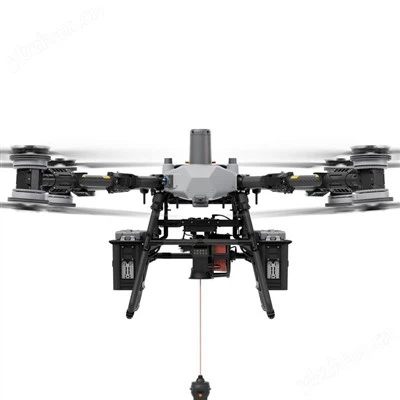
T40 Spray DroneThe T40 spray drone offers transformative advantages for large-scale precision agriculture. Its revolutionary Coaxial Twin Rotor design enables an industry-leading 40kg spray and 50kg spread payload,

Why Choose Us
Advanced Manufacturing Capabilities
We operate three production bases and six workshops covering carbon fiber components, metal processing, wire forming, and full system assembly. This integrated setup allows us to maintain strong advantages in quality control, cost efficiency, and production consistency.
PSDK Development Expertise
Our R&D team includes senior engineers with experience from leading companies such as DJI, Huawei, and Parrot. With a strong focus on industrial heavy-payload drone applications, the team brings solid expertise in DJI PSDK-based system development.
Professional Training Services
We provide tailored training programs based on customer needs, covering delivery drones, FPV drones, and agricultural drones. To support faster learning, we also supply standardized online video tutorials to help users quickly master operation and maintenance skills.
Customized Solutions
We deliver end-to-end customized solutions for industries such as logistics, firefighting and rescue, power line inspection, high-altitude cleaning, and agricultural protection. Our services range from equipment selection and configuration to full system integration and deployment.
Specification
|
Aircraft Specification |
|||
|
Model number |
T40 |
Max flight radius |
2000m |
|
Weight |
38kg |
Max wind resistance |
6m/s |
|
Max wheelbase |
218.4cm |
Folded size |
112.5×75×85cm |
|
Propeller & Propulsion System |
|||
|
Stator size |
100x33mm |
Propeller size |
54-inch |
|
Propeller quantity |
8pcs |
Motor KV value |
48RPM/V |
|
Motor power |
4000W/rotor |
Hovering time |
18 minutes |
|
Dual Atomizing Spraying System |
|||
|
Water tank capacity |
40L |
Payload |
40kg |
|
Sprinkler model |
LX8060SZ |
Sprinkler quantity |
2 |
|
Droplet size |
50-500 μm |
Max effective spray width |
11m |
|
Pump model |
Magnetic drive impeller pump |
Flow rate |
6L/min*2 |
|
Spreading System |
|||
|
Applicable materials |
Solid dry particles with a diameter of 0.5 to 5 mm |
Spread tank volume |
70L |
|
Spreading payload |
50kg |
Spread width |
7m |
Advantages of Agricultural Large Drone
Precision and Efficiency: Agricultural large drones can precisely target areas that need spraying, reducing wastage of chemicals and ensuring even coverage. This precision leads to more efficient use of resources and cost savings.
Accessibility: Agricultural large drones can access hard-to-reach or uneven terrain that is challenging for traditional spraying equipment, allowing for more thorough coverage of crops.
Time-Saving: Agricultural large drones can cover large areas in a relatively short amount of time compared to manual spraying or even tractor-mounted sprayers, saving time and labor costs.
Safety: By using agricultural large drones, farmers can reduce their exposure to chemicals, as they do not need to be in close proximity to the spraying area. This can improve overall safety for farm workers.
Environmental Benefits: Agricultural large drones can reduce chemical runoff and drift, which can occur with traditional spraying methods, leading to less environmental impact.
Flexibility: Agricultural large drones can be easily deployed and repositioned, allowing for more flexible spraying schedules and adaptation to changing field conditions.
Types of Agricultural Large Drone
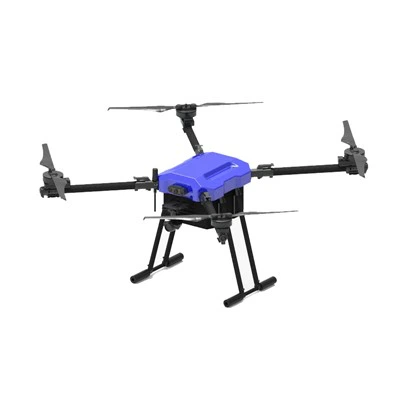
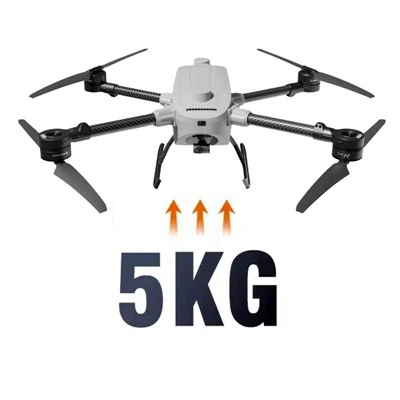
Multi-rotor Agricultural drones , such as quadcopters and hexacopters, are a kind of UAV with multiple rotors (typically four, six or eight), which are popular in agriculture due to their maneuverability and stability. They are equipped with multiple rotors that allow them to hover in place, fly at low altitudes, and capture high-resolution imagery. Multi-rotor agriculture uavs are suitable for tasks that require close and contained object capture, such as monitoring crop health, detecting pests and diseases, and applying targeted treatments.
Fixed-wing Agricultural drones have a wing-like structure and are designed to fly like airplanes. Fixed-wing drones have only one propeller and a rigid wing structure that persists in a fixed position throughout the flying. As a result, fixed wing drones have longer battery lives, with the potential to stay in the air for 20 minutes or longer. They are known for their long-flight endurance and ability to cover large areas.
Hybrid Agricultural drones combine the features of multi-rotor and fixed-wing drones, offering both efficiency in covering large areas and maneuverability in navigating complex terrain. They can take off and land vertically like multi-rotor ag drones and then transition to fixed-wing flight for longer endurance and coverage. Hybrid ag drones are suitable for applications that require both close-range imaging and large-scale mapping, providing flexibility and versatility in agricultural operations.
Materials of Metric Roller Chain Sprocket
◆ RGB Cameras : RGB (Red, Green, Blue) sensors, also known as standard or color cameras, are the most common type of sensor used in agriculture drones. While they may not provide the detailed spectral information of multispectral or hyperspectral sensors, RGB sensors are still valuable for capturing high-resolution color images of fields and crops.
◆ Multispectral Cameras: Multispectral cameras have more than one lens, each with a different filter. These filters allow the lens to focus on selected wavelengths, including the near-infrared (NIR) and visual (VIS) spectrum. These sensors are commonly used in agriculture to assess crop health, monitor vegetation indices (like NDVI), and detect areas of stress or disease in crops.
◆ Hyperspectral Sensors: Hyperspectral sensors capture data in many more narrow and contiguous bands across the electromagnetic spectrum compared to multispectral sensors. This high spectral resolution allows for detailed analysis of materials and substances, enabling identification and characterization of specific plant species, stressors, and chemical compositions. Hyperspectral imaging is used in precision agriculture for detailed crop analysis, disease detection, and nutrient assessment.
◆ Thermal Cameras: Thermal sensors, also known as infrared (IR) sensors, measure the thermal radiation emitted by objects. In agriculture, thermal sensors are used to assess crop temperature, which can indicate stress levels, irrigation effectiveness, and plant health. Thermal imaging can help identify areas with water stress, pest infestations, or disease, allowing for targeted interventions and improved crop management.
◆ LiDAR: Light detection and ranging (LiDAR) uses lasers to create 3D maps and detect the distance of objects, enabling farmers to analyze topographical data, identify crop patterns, and plan for more efficient planting. These sensors are very accurate at mapping landscape elevations. They are also fairly expensive to deploy on agricultural drones. Elevation can also be measured with drones using overlapping images (also called photogrammetry), which could be done with a regular camera at lower cost, but with reduced accuracy when compared to LiDAR.
Applications of Agricultural Large Drone
Crop Spraying: Agricultural large drones equipped with spraying equipment can apply fertilizers, pesticides, and herbicides to crops more precisely and efficiently than traditional ground-based methods. This reduces chemical use and minimizes exposure to farm workers.
Crop Monitoring: Agriculture uavs equipped with cameras or multispectral sensors can monitor crop health by capturing images that show variations in plant health, water stress, and pest infestation. This data helps farmers make informed decisions about irrigation, fertilization, and pest control.
Field Mapping: Agricultural large drones can create detailed, high-resolution maps of fields, including elevation, drainage, and soil variation. This information is valuable for planning seed planting patterns, optimizing irrigation, and managing land use.
Precision Agriculture: By using agricultural large drones to collect data, farmers can practice precision agriculture, where inputs such as water, fertilizers, and pesticides are applied only where and when they are needed. This reduces waste, improves crop yields, and minimizes environmental impact.
Livestock Monitoring: Agricultural large drones can be used to monitor livestock, helping farmers keep track of their animals' health, behavior, and location. This information can lead to better animal welfare and more efficient herd management.
After-Sales Service
Standard Warranty
1. Service Content: Free repair for material and workmanship defects. Core components (such as main controller and gimbal camera) are typically covered by a 12-month warranty, and batteries are covered by a 12-month warranty with fewer than 200 cycles.
2. Applicable Situations: Non-human-caused product quality issues.
Value-Added Services
1. Service Content: Accidental damage replacement service. For example, Intlbit Care "Replace Anytime" provides two replacement opportunities within 12 months.
2. Applicable Situations: Damage caused by accidental explosions, water damage, drops, etc.
Third-Party Repair Services
1. Service Content: Provided by independent repairers, with a wide range of services.
2. Applicable Situations: Repair needs that are out of warranty or do not meet the official warranty conditions.

Packaging and Shipping
|
Packaging |
Standard export carton or custom reinforced flight case (optional) |
|
Transportation methods |
Air freight, sea freight, or express delivery based on order requirement |
FAQ
We're well-known as one of the leading agricultural large drone manufacturers and suppliers in China, also support customized service. Please feel free to wholesale agricultural large drone for sale here and get free sample from our factory. For price consultation, contact us.
smart agriculture drone, agricultural large drone, commercial drones for agriculture