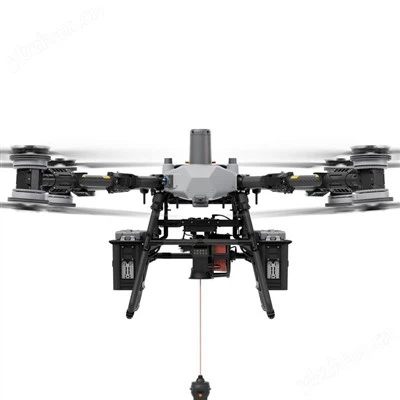
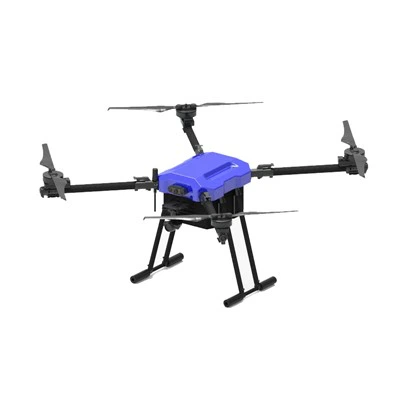
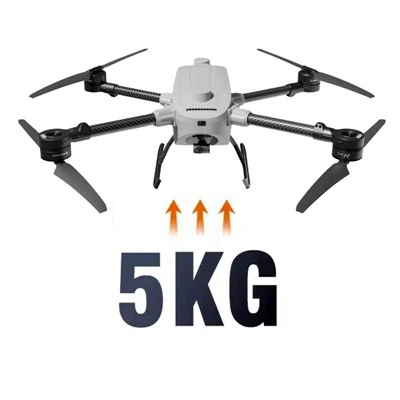
Delivery drones are octocopter aircraft equipped with a GPS self-control navigation system, an iGPS receiver, various sensors, and wireless signal transceivers. They feature multiple flight modes, including GPS self-control navigation, fixed-point hovering, and manual control. The drones integrate multiple high-precision sensors such as a three-axis accelerometer, a three-axis gyroscope, a magnetometer, and a barometric altimeter, along with advanced control algorithms. Each drone is equipped with a black box to record status information. Furthermore, the drones have a fail-safe function; when they enter a fail-safe state, they will automatically maintain precise hovering, and if the fail-safe period expires, they will fly to the nearest delivery distribution center. The drone transmits data to the dispatch center and self-service parcel lockers via 4G networks and radio communication remote sensing technology. It sends its geographic coordinates and status information to the dispatch center in real time, receives instructions from the center, and flies in GPS autonomous navigation mode after receiving the destination coordinates. Upon entering the target area, it sends a landing request, a mission report, and a status report to the parcel locker. After receiving a response to the landing request, the parcel locker guides the drone to land on its top platform, load and unload parcels, and perform rapid charging. If the drone sends a request but receives no response and the timeout period expires, it sends another request to the destination locker. After three timeouts, it sends a landing request anomaly report, a mission status report, and a status report, along with instructions, to the dispatch center. If the drone loses contact with the dispatch center or experiences a malfunction, it will autonomously fly to the parcel distribution center.
Self-service parcel locker The express cabinet is equipped with a computer, a drone queuing decision system, an express management system, an iGPS positioning system , a drone landing guidance system, a loading and unloading express parking platform, eight temporary parking platforms, a mechanical conveying system, four self-service express terminals and multiple express boxes. All parking platforms on the top of the express cabinet have fast charging function. After the drone sends a landing request, a local task report and a local operating status report to the express cabinet, the express cabinet inputs the drone number, the drone's task and task priority into the system. The queuing decision system allocates parking platforms, and the drone landing guidance system guides the drone to land, or issues a hovering waiting instruction to the drone. After the drone receives the landing instruction from the express cabinet, it will continuously transmit the infrared laser positioning signal received by the iGPS receiver on its own machine and the local number back to the express cabinet. The express cabinet will accurately grasp the drone's coordinate information and guide the drone to land accurately. When the express cabinet is in a state of drone queue congestion, it will send a queue congestion report to the dispatch center, and the dispatch center will stop sending the loading and unloading instructions of this express cabinet to the drone. The parcel locker will send its parcel list information to the dispatch center in real time, including basic parcel information, parcel priority, parcel delivery time, and parcel congestion status reports. Parcel lockers can be installed in residential communities or on the rooftops of some buildings, depending on the scale of business and cost considerations. Parcel lockers are also equipped with cameras to monitor and record the surrounding environment in real time, ensuring the safety of users' parcels and the system facilities. When a user delivers a parcel through the locker: after pressing the delivery button, if the locker is not full, an empty delivery box door will pop open. The user takes a parcel box from the parcel box shelf, puts the parcel inside, places the box in the delivery box, and closes the door. The delivery box will check if the parcel meets the standards, including weight and risk level. If it meets the standards, the user will be prompted to enter delivery information and delivery level. After confirming the destination is reachable, a price will be given based on the parcel weight, delivery distance, and delivery priority. The user can pay on-site, or the recipient can pay online or upon delivery, depending on their needs. After the parcel locker fully accepts the package, it will send package information to the parcel box via Bluetooth. The parcel box will record the package information for identification. After the drone docks with the locker, it unloads the parcel box, which is then carried into the parcel locker by a mechanical conveyor. The locker will verify the package based on the drone's mission report and the information in the parcel box's memory module, and send a text message to the user notifying them of the package's arrival, along with a retrieval code and helpful tips. If the user exceeds the time limit for receiving the package, a parcel locker occupancy fee will be charged based on the duration. If the system's preset time limit is exceeded, the package will be returned or transferred to a parcel distribution center.