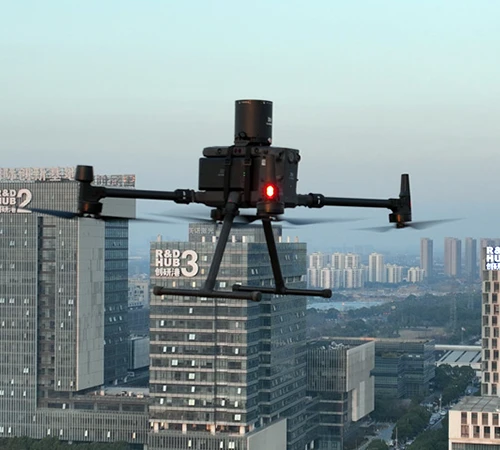
Photovoltaic cleaning drones are drone devices specifically designed for cleaning photovoltaic (solar) panels. They utilize cleaning devices (such as water spray systems, brushes, or airflow devices) to remove dust, dirt, and bird droppings from the surface of the photovoltaic panels, thereby improving the power generation efficiency of the panels. Photovoltaic cleaning drones typically possess autonomous flight capabilities, efficiently completing cleaning tasks along preset paths, making them particularly suitable for the maintenance of large-scale photovoltaic power plants.
Their core feature lies in their connection to a ground power supply or cleaning fluid supply system via a tethering device (usually a high-tensile-strength, lightweight composite material cable), enabling long-term hovering and stable operation. This overcomes the limitations of traditional drones, such as short flight time and limited payload capacity, making them especially suitable for cleaning and maintenance of high-altitude facades, bridges, wind turbine blades, and large billboards.
With advancements in AI technology and new materials science, high-altitude tethered cleaning drones are developing towards intelligence and modularity. For example, some companies have developed drones equipped with visual recognition systems that can automatically identify stain types and adjust cleaning parameters; the use of carbon fiber composite materials for tethering cables has reduced weight by 30% while increasing load-bearing capacity by 50%. However, this field still faces two major challenges: first, the standardization of cleaning effects, as there is currently a lack of a unified cleaning quality assessment system, leading to significant differences in results across different scenarios; and second, adaptability to complex environments, such as strong electromagnetic interference and extreme temperature differences (-30℃ to 50℃), where equipment stability still needs improvement. In the future, with the integration of 5G and AI technologies, high-altitude tethered cleaning drones are expected to achieve fully autonomous operation, further driving the transformation of the high-altitude cleaning industry.